LLM model drift causes AI products to degrade silently in production. Learn the three mechanisms behind silent failures, what an AI observability stack actually covers, and how funded startups catch model drift before users do.
AI products degrade silently in production because LLM providers update model behavior without notice, training data drifts from real-world usage, and most startups have no observability layer watching output quality. The first signal is usually a user complaint.
Most teams find out their AI product has degraded the same way. A user tweets about it. A support ticket comes in. A customer threatens to churn. By the time the problem has a name, it has been happening for weeks.
This is not a model problem. It is an infrastructure problem. Specifically, it is the absence of the infrastructure layer responsible for watching what your model is doing after you ship it.
You have monitoring for uptime. You probably have alerts if your API returns 500 errors. But do you have anything watching whether your LLM outputs are still accurate, relevant, and behaviorally consistent with what you deployed six months ago?
If the answer is no, you are not alone. Most funded AI startups are in the same position. And it is the most predictable failure mode in production AI today.
What Is LLM Model Drift and Why Does It Happen?
Model drift in LLM applications is the gradual, often unnoticed degradation in model performance as real-world usage, user behavior, and upstream provider changes diverge from the conditions the system was designed for.
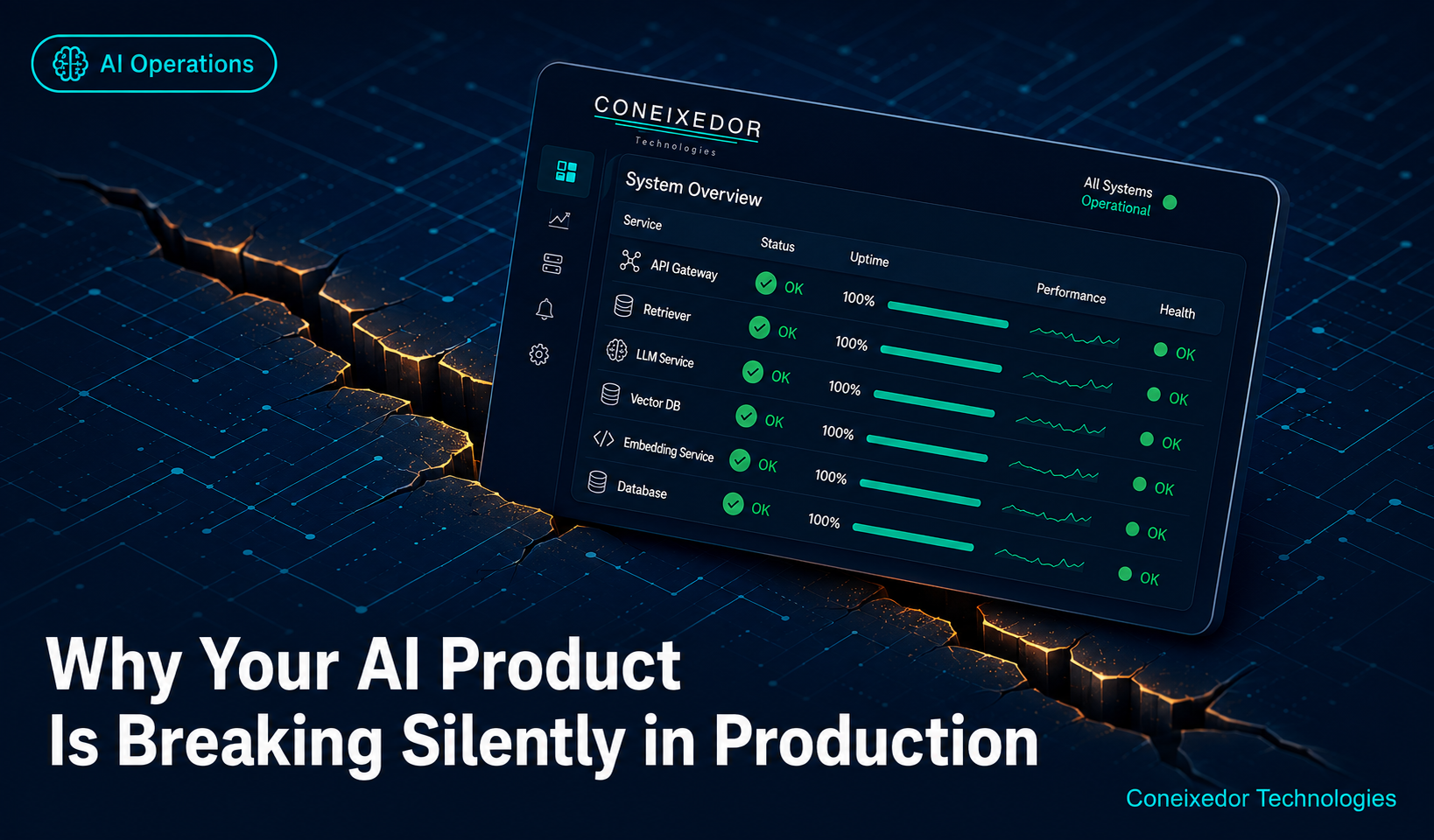
Unlike traditional software, AI products can fail without throwing an error. A silent failure looks like this: the model returns a response, the pipeline completes, the logs show green, and the user gets an answer that is subtly wrong, unhelpfully vague, or behaviorally different from what they expected. No alert fires. No engineer gets paged.
There are three primary mechanisms driving LLM drift in production:
Provider drift. Developers on Reddit's r/LLMDevs documented GPT-4o behavioral changes in February 2025 with zero advance notice from OpenAI. JSON parsers broke. Classifiers failed silently. The model version was nominally the same. The behavior had changed. Most teams found out from their users.
Data drift. Your retrieval layer was designed around the questions your early users asked. Your real users ask different things. The gap between the questions your RAG pipeline was built for and the questions it is actually receiving grows wider over time without any visible signal.
Prompt drift. Product updates, A/B tests, and engineering changes accumulate. What started as a carefully tuned system prompt has been edited six times by four different people. Each change was small. The cumulative effect on output quality was not.
Why Does This Go Undetected for So Long?
Traditional monitoring was designed for deterministic systems. If your API returns a 200 status, the monitoring system believes everything worked. LLM outputs are not deterministic. A response can complete successfully and still be wrong, degraded, or behaviorally inconsistent with your product's intent.
Most AI startups have invested in application performance monitoring for their infrastructure and nothing for their model behavior layer. The result is a growing blind spot that gets more expensive the longer it exists.
Research consistently describes model drift as the silent threat to AI investments. The business consequences follow a predictable sequence: output quality declines, users notice before engineers do, trust erodes, churn follows.
What Does a Proper AI Observability Stack Actually Cover?
An observability stack for an AI product in production needs to cover more than uptime and latency. My team builds these across three layers:
Layer 1: Output quality monitoring. Tracking semantic consistency of responses over time. Automated evaluation against a golden dataset. Alerting when response distributions shift beyond a defined threshold.
Layer 2: Retrieval layer monitoring. For RAG-based products, tracking retrieval accuracy, context relevance scores, and freshness of the underlying data. A retrieval layer that worked at launch degrades as your data grows without corresponding infrastructure changes.
Layer 3: Provider behavior tracking. Logging model version, behavior signatures, and output patterns to detect provider-side changes before users do. When a provider silently updates a model, you want to know within hours, not weeks.
How Does a Production AI Product Know When to Escalate?
A properly instrumented AI product has defined thresholds for what constitutes normal output behavior and automated alerts when those thresholds are breached. This requires a baseline established at deployment, continuous evaluation running in production, and a clear escalation path that does not depend on a user complaint to start the investigation.
This is not a research-stage concern. It is an operational requirement for any AI product that is in the hands of paying customers.
What Happens to AI Startups That Do Not Address This?
The pattern is consistent. A funded AI startup ships a product that works well at launch. The team moves on to the next feature. Six months later, usage has plateaued. NPS has dropped. The CTO traces the decline and finds that model behavior changed two months ago and nobody caught it.
The engineering team is blamed. The real problem is that there was never any infrastructure watching for it.
One hour of user-facing degradation in a production AI product costs a Series A company in reputation, support load, and contract risk. The cost compounds silently because the degradation is invisible until it is not.
The fix is not complex. But it requires treating model observability as infrastructure, not as a nice-to-have.
The First Step Is Knowing What You Do Not Know
A free Infrastructure Reality Check with Coneixedor Technologies takes thirty minutes. It covers your current observability posture, your model monitoring gaps, your retrieval layer health, and the specific risks your production AI product is carrying right now.
Most CTOs leave the call with a clear picture of problems they suspected but could not quantify, and risks they did not know existed.
Infrastructure that never becomes the reason your AI product falls behind starts with knowing where the gaps are.
Frequently Asked Questions
LLM model drift is the gradual degradation of an AI product's output quality in production, caused by changes in user behavior, upstream provider updates, data freshness issues, or accumulated prompt changes. Unlike traditional software bugs, drift is silent and has no error code. The pipeline completes successfully while the user receives degraded outputs.
Signs include declining user engagement, rising support tickets about response quality, or A/B tests that show output behavior deviating from baseline. Without active observability, most teams find out from users rather than from their monitoring stack. A properly instrumented AI product detects drift through automated evaluation before users report it.
An outage is visible: the pipeline breaks and monitoring alerts fire. Drift is not: the pipeline completes while outputs degrade silently. Monitoring infrastructure that only watches for uptime and error rates cannot detect drift. Detecting drift requires output quality monitoring, not just infrastructure monitoring.
Fixing drift requires an observability layer that monitors output quality over time, not just pipeline uptime. This includes automated evaluation against a golden dataset, retrieval accuracy monitoring for RAG systems, and provider behavior tracking to detect upstream changes. A free Infrastructure Reality Check call can assess your current observability posture and identify specific gaps.