GPU compute costs are unpredictable and compound faster than most AI teams expect. Here are the 3 main cost drivers and the specific tactics that reduce spend without touching model quality.
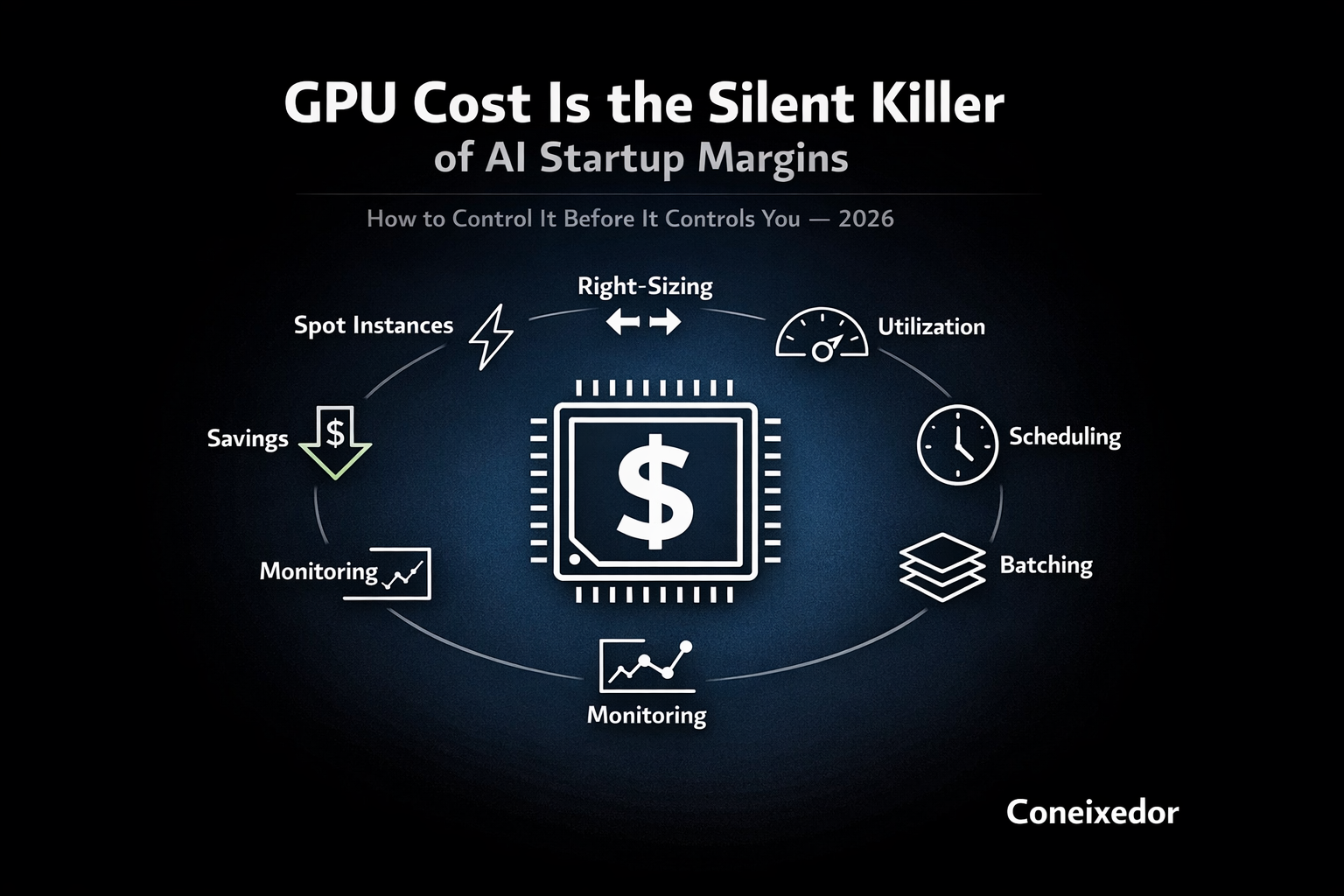
GPU cost is the silent killer of AI startup margins. The problem is not that GPU compute is expensive. The problem is that it is unpredictably expensive, and it compounds faster than most teams expect.
The 3 main cost drivers, and why each one is invisible until it is not
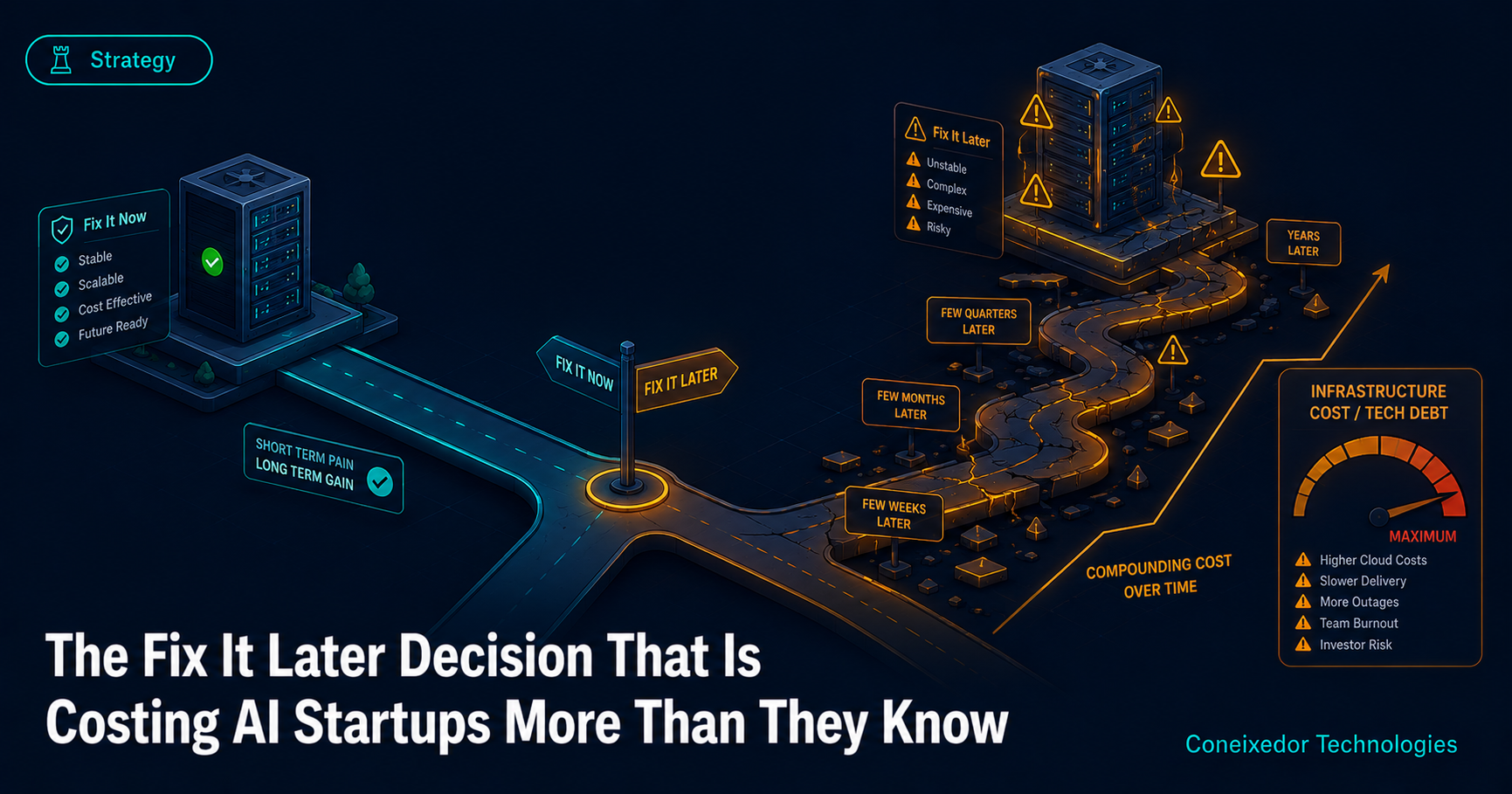
The three main GPU cost drivers in AI startups are over-provisioning, inference inefficiency, and no auto-scaling.
Over-provisioning is the most widespread problem in AI startup infrastructure. Teams size GPU instances for peak load, then run at 20% utilisation 80% of the time. The invoice arrives based on what you provisioned, not what you used.
This waste is invisible in standard monitoring. Dashboards that track uptime and latency tell you if the system is working. They do not tell you how efficiently it is using the hardware you are paying for. Most teams discover the extent of their over-provisioning only when they pull utilisation percentiles for the first time.
Inference inefficiency is the second driver. When a serving layer processes requests sequentially, one at a time, the GPU sits idle between requests while the next one queues. On the same hardware, batching can handle ten times the volume at a fraction of the cost per request. Most teams do not implement batching because sequential processing works in development and nobody benchmarks cost until scale forces the conversation.
Inference inefficiency compounds with growth. As request volume increases, sequential processing requires proportionally more hardware to maintain the same throughput. With batching, you absorb significant growth before needing to add capacity. The teams that implement batching early end up with a structural cost advantage that widens as they scale.
No auto-scaling is the third driver, and the most straightforward to address. GPU capacity is expensive at idle. Paying for 100% capacity during the 10% of time you actually need it means the majority of your off-peak GPU spend is pure waste. Auto-scaling converts this fixed cost into a variable one that tracks actual demand.
Many teams skip auto-scaling because GPU instances take longer to start than standard compute. The fix is a warm pool: keep a minimum number of instances running and auto-scale above that floor based on queue depth or request rate. For most AI startup workloads, this approach eliminates off-peak waste without introducing noticeable latency during traffic spikes.
Specific tactics that reduce cost without touching model quality
You can reduce GPU spend by 30-50% through right-sizing, batching, and caching, without changing a single model parameter.
Right-sizing starts with real data. Pull 30 days of GPU utilisation percentiles, P50 and P95, for each instance type you are running. Do not use average utilisation or your peak-day estimate. Use the percentile distribution to find the instance type that covers your actual P95 without being massively over-provisioned for the rest of the time.
Most teams find their instances are two to four times larger than their actual workload requires. A team running an A100 at a P95 utilisation of 38% can typically move to a smaller instance class with no latency regression and a 25-35% reduction in compute cost. Right-sizing alone, with no other changes, commonly delivers meaningful savings within the first billing cycle.
Inference batching is the highest-leverage optimisation for teams with non-real-time workloads. Document processing, classification, embeddings generation, and offline scoring are all candidates. Group requests into batches of 8 to 32, depending on your GPU memory and workload characteristics, and process them in a single forward pass. Cost per inference drops proportionally to the effective batch size.
For latency-sensitive workloads, micro-batching provides a middle path. With a 50 to 100 millisecond collection window, you can group requests that arrive close together without making individual users wait meaningfully longer. For most AI products, P50 latency increases of under 100 milliseconds are invisible to users and far outweighed by the cost reduction.
Spot instances apply to any workload that tolerates interruption. Training runs are the obvious case: they are long, checkpointable, and have no real-time requirement. Offline inference jobs, batch scoring pipelines, and nightly report generation are also strong candidates. Spot pricing on major cloud providers runs 60-70% below on-demand rates for the same GPU type. For training workloads, the savings are immediate and require minimal engineering to implement.
Semantic caching is often the most surprising optimisation in its impact. When two queries are semantically similar above a defined threshold, the second query can be served from the cache without touching the GPU at all. For products where users ask similar questions, run similar classifications, or generate similar content, cache hit rates of 30-40% are achievable. On those workloads, semantic caching alone reduces live inference volume by one third, which translates directly to compute cost.
The observability layer: you cannot optimise what you are not measuring
Three metrics tell you where the GPU waste is: cost per inference, tokens per request, and GPU utilisation percentiles.
Cost per inference is the unit economics of your AI feature. It tells you what each successful response costs to produce, which makes optimisation decisions concrete rather than directional. Without this number, choices about right-sizing, batching, and caching are made on intuition rather than data.
Cost per inference also reveals which endpoints are expensive and which are not. When you have cost visibility at the endpoint level, you know where optimisation effort returns the most. In practice, the most expensive endpoint is almost always the right place to start, and it is almost never the one the team assumed it would be.
Tokens per request, tracked as P50 and P95 broken down by endpoint, catches prompt engineering regressions before they arrive in your cloud bill. A single change to a system prompt, an added example, or an unintended loop in prompt construction can multiply token usage by five overnight. Teams that track this metric catch the regression at deployment time. Teams that do not catch it at billing time.
Token usage also compounds across request volume. At low traffic, a prompt regression is a minor cost issue. At high traffic, the same regression can double your monthly GPU spend within days. Treating token usage per request as a first-class deployment metric prevents the kind of cost surprise that forces emergency engineering work during high-growth periods.
GPU utilisation percentiles, specifically P50 and P95, reveal over-provisioning that average metrics obscure. An average utilisation of 45% suggests a reasonably sized instance. The same instance with a P50 of 18% and a P95 of 88% tells a different story: you are paying for capacity you need only during rare spikes and idling through most of your working hours. Right-sizing becomes straightforward once you see the distribution rather than the average.
The P99 utilisation completes the picture. If your P99 sits above 85%, you have a real spike problem that needs either a capacity increase or an auto-scaling policy with a shorter spin-up time. If your P99 is consistently below 70%, you are paying for capacity that no workload ever fully uses, and a smaller instance type is almost certainly the right move.
A real example: cutting costs without touching the model
One fintech client reduced their GPU spend by 45% in 8 weeks through batching and semantic caching alone. Same model. Same accuracy. Radically better unit economics.
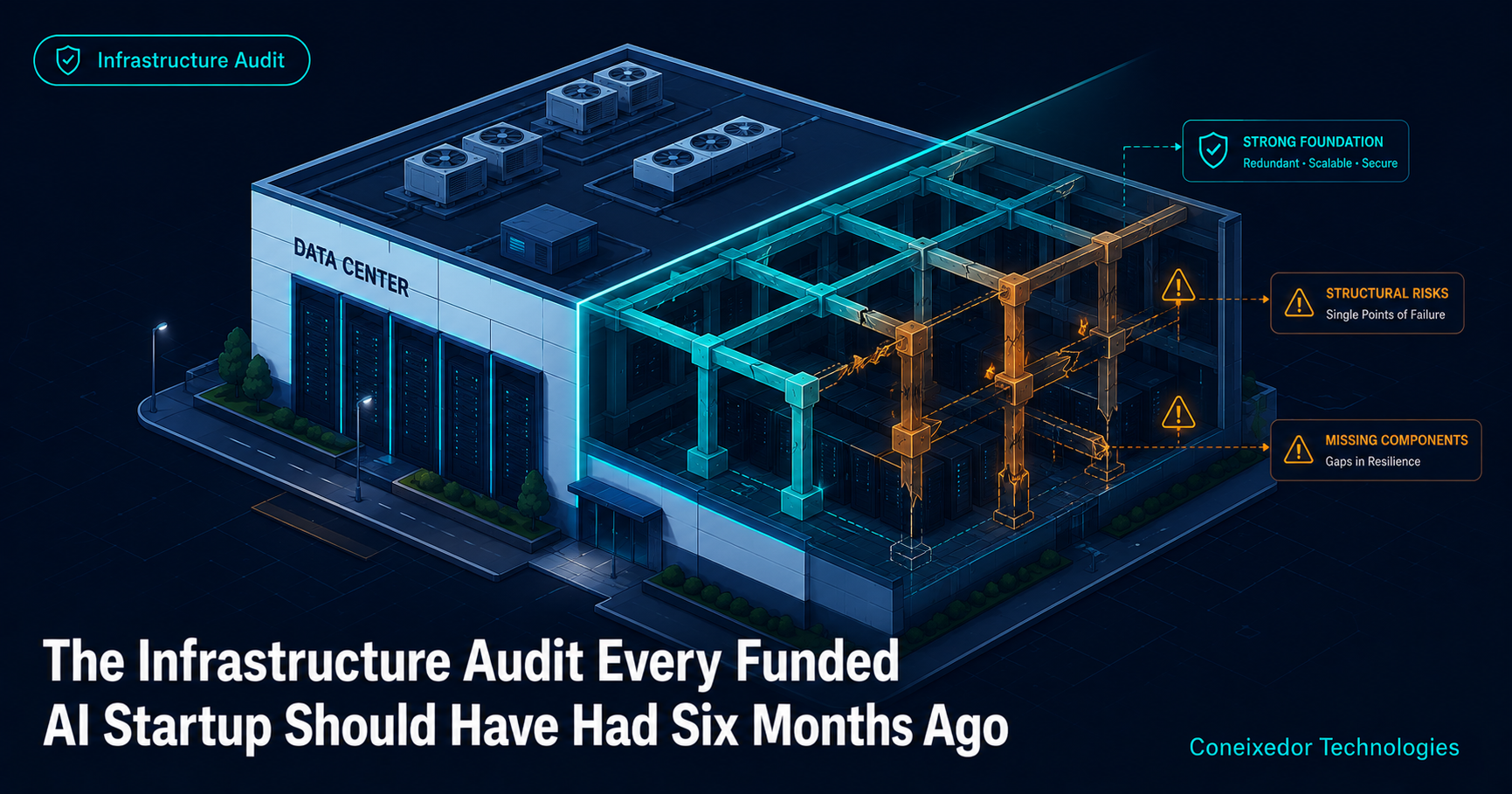
The audit found three problems. Requests were being processed sequentially despite a document processing workload with a five-minute delivery window and no real-time requirement. There was no caching layer despite 40% of incoming queries being near-duplicates of previous queries within the same session. The GPU instance had been sized for the single highest-traffic day of the previous year, which had never repeated.
None of these issues appeared in the team's existing monitoring. Their dashboards tracked uptime, P50 latency, and HTTP error rate. They did not track cost per inference, GPU utilisation percentiles, or query similarity distributions. The waste was compounding monthly, but it was invisible in the metrics they were watching.
The changes were targeted and did not require touching the model. Inference batching was implemented for the document processing workload, grouping requests into batches of 16 with a 30-second collection window that fit comfortably within the five-minute delivery requirement. A semantic cache was deployed upstream of the model for queries scoring above a 0.92 cosine similarity threshold, using a lightweight embedding model to compute similarity at negligible cost.
The GPU instance was right-sized using 30 days of actual P95 utilisation data, dropping to a smaller instance type that still covered the P95 load with headroom. Total engineering time from audit to deployment was under three weeks. There were no model changes, no accuracy regressions, and no latency increases visible at P50 or P95 for any endpoint.
Eight weeks after deployment, GPU spend had dropped by 45%. Cost per inference had halved. The engineering team had budget freed to invest in the fine-tuning work they had been deferring for six months due to infrastructure costs. The optimisation work paid for itself within the first billing cycle after deployment.
When GPU costs are predictable and optimised, the engineering conversation shifts. Instead of defending the cloud bill in every board meeting, the team is talking about what to build next. Infrastructure should be an enabler, not a budget anxiety item.
Drop COST in the comments on LinkedIn and I will share the GPU optimisation framework we use with AI startup clients. Or Book Your Free Infrastructure Reality Check.
Frequently Asked Questions
GPU compute costs vary widely. A single A100 instance on AWS runs $3-5 per hour. At scale, inference costs for production AI products commonly reach $10,000-50,000 per month without optimisation.
The three highest-impact tactics are: right-size GPU instances using actual percentile data, implement inference batching for non-real-time workloads, and add semantic caching for repeated queries.
Inference batching groups multiple requests together and processes them in a single GPU pass. For non-latency-sensitive workloads, this can reduce compute costs by 30-70% with no change to model quality.