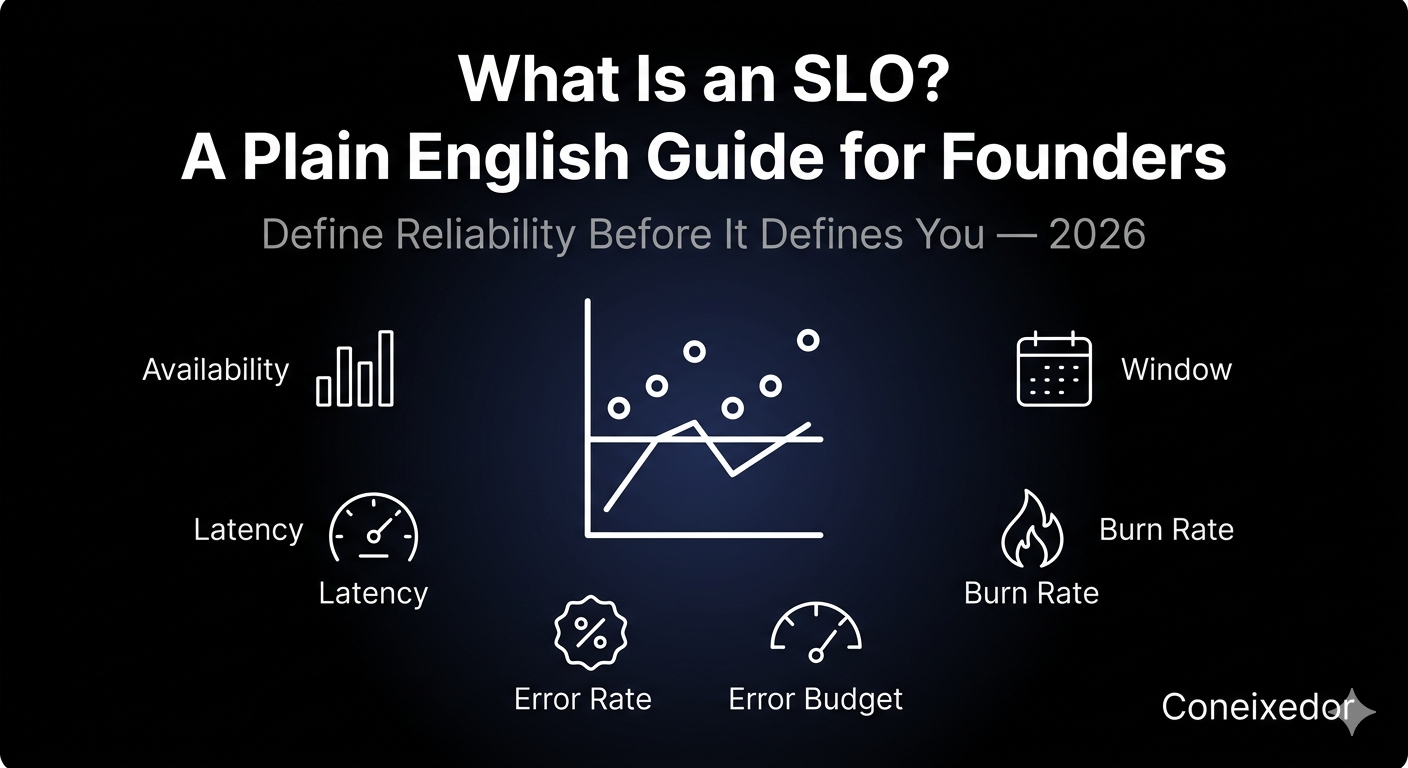
SLOs are the most important reliability tool most startup founders have never used. Here is what they are, why they matter more than uptime percentages, and how to set your first one in three steps.
Your uptime percentage is lying to you. A service can be up and still be failing its users. SLOs are the tool that reveals the truth, and makes reliability a conversation your whole team can have.
Consider what most startup monitoring actually tracks: whether the servers are running. When everything shows green on the dashboard, the natural assumption is that the product is working. But a checkout page that consistently takes 8 seconds to load shows green uptime. A payment API that silently fails 3% of requests shows green uptime. An authentication service that succeeds but returns stale session data shows green uptime. The gap between "the servers are up" and "users are getting what they came for" is exactly where the most damaging reliability problems live.
SLOs, or Service Level Objectives, are the tool that closes that gap. They shift reliability measurement from infrastructure metrics to user-experience metrics. This guide explains what SLOs are, why they matter more than uptime percentages, and how to set your first one in a two-hour session with your engineering lead.
What an SLO is — and a real example
An SLO (Service Level Objective) is a specific, measurable promise your engineering team makes about what your system delivers to users.
Every word in that definition is load-bearing. Specific means it covers a named user journey, not the overall system in aggregate. Measurable means there is a number attached that can be tracked continuously and without ambiguity. Promise means the team owns it and can be held accountable when it is missed. And delivers to users means the target is framed from the user's perspective, not the infrastructure's.
Here is a concrete example of a complete SLO: 99.9% of checkout requests will succeed within 2 seconds over a rolling 30-day window. Walk through what it specifies. The user journey is checkout. The success condition is the request completing without an error response. The latency target is 2 seconds. The threshold is 99.9%. The measurement window is rolling 30 days. Every element is specific and measurable. Compare this to "we aim for high availability." That phrase has no user journey, no metric, no threshold, and no measurement window. Nobody can tell you on a given Monday whether the SLO was met last week.
The measurement window deserves attention because it is a policy decision built into the SLO structure. A rolling 30-day window means a bad week gets diluted by three good weeks before it registers as a breach. Your reliability measurement has inertia. A rolling 7-day window surfaces problems faster and compels faster responses. There is no universally correct choice: start with 30 days and adjust based on how quickly you need problems to force action.
The reason SLOs matter more than uptime percentages comes down to framing. Your users do not experience your infrastructure. They experience your product. An SLO written around a user journey, such as checkout success rate or search response latency, maps directly to what users care about. An uptime percentage maps to what your ops team cares about. Both numbers matter. Only one drives the conversations that actually improve the product.
SLO vs SLA vs SLI — the three terms that confuse everyone
SLI (Service Level Indicator) is the measurement. SLO is the target. SLA (Service Level Agreement) is the contract with consequences. You need all three, but you start with the SLI and SLO.
An SLI is the raw metric your monitoring system produces continuously. The percentage of checkout requests that succeeded in the last 30 days is an SLI. The median API response time in the last 24 hours is an SLI. The error rate on your authentication endpoint is an SLI. These numbers exist in your observability platform right now, whether you have defined SLOs or not. What SLIs lack is judgment. A checkout success rate of 99.2% is a number. Whether 99.2% is acceptable or alarming depends entirely on what you decided it should be.
An SLO is the threshold that turns the SLI into a signal. You define: 99.9% of checkout requests will succeed. Now 99.2% means something specific. It means the team missed the target by 0.7 percentage points. That is actionable. Before the SLO, 99.2% was just a number in a dashboard. After the SLO, it is a reliability failure that demands a response.
An SLA is what happens when an SLO becomes a commercial commitment. If the 99.9% checkout success rate is written into a customer contract that triggers service credits or financial penalties when missed, that is an SLA. For most early-stage startups, SLAs are premature. You do not want to make contractual promises about reliability targets you have not demonstrated the ability to meet consistently. The sequence that works: define your SLIs, set your SLOs, prove you can meet them over time, then formalise the most critical ones into SLAs for enterprise customers who require them.
How to set your first SLO in three steps
You can define your first SLO in two hours without specialist knowledge. The three steps are: pick the user journey, pick the metric, agree on the threshold.
Step 1: Pick the user journey that matters most. The right starting point is not the user journey you are most proud of engineering. It is the one whose failure is most costly to your users and to your business. For most SaaS startups, this is the payment flow, the core product action users take every day, or login. Test your choice with this question: if this journey breaks silently for 30 minutes on a weekday afternoon, how many users are affected and what does it cost? The journey with the most severe answer is your starting point.
Step 2: Pick the metric. Three SLI types cover the majority of early-stage startup use cases. Availability measures what percentage of requests complete without returning an error. Latency measures how fast requests resolve from the user's perspective. Throughput measures how many requests the system handles per unit of time. For a first SLO, availability and latency together tell the essential story: does the journey work, and does it work fast enough for users to stay in the product? Throughput becomes relevant later when scaling is the primary concern.
Step 3: Agree on a realistic threshold. This is where most teams make the same mistake: setting a target based on what feels right rather than what the data shows. Do not commit to 99.99% availability if you have never measured whether you are currently delivering 99.5%. Pull the last 30 days of actual SLI data for the journey you chose and find your baseline. Set your first SLO at a level you are confident you can meet now, with a small improvement buffer. For most SaaS products, 99.5% success rate and P75 response time under 500ms is both aspirational and achievable as a starting point. Write it down, share it with the full engineering team, and review it in your weekly engineering meeting.
A common mistake after this step: writing the SLO down and forgetting about it. The SLO is not a document. It is a standing agenda item. The team needs to know whether the SLO was met last week and what changed. That review habit, more than anything else in the SLO process, is what turns a reliability target into a reliability practice.
What happens when you break your SLO — introducing the error budget
When you break your SLO, you spend from your error budget. When the budget runs out, you stop shipping features and fix reliability first.
An error budget is the inverse of your SLO: the maximum amount of unreliability the SLO permits during the measurement window. If your SLO is 99.9% success rate over 30 days, your error budget is 0.1%. Over a 30-day month of 720 hours, that is 43 cumulative minutes of acceptable failure. It is not a single 43-minute outage allowance. It is 43 total minutes of degradation accumulated across the entire month. Every incident, every elevated error rate, every deployment that causes a brief period of increased failures, draws from that account. When the account empties before the month does, reliability work takes priority over everything else.
The error budget changes how deployment and prioritisation decisions get made. Without one, the reliability versus speed question is a perpetual negotiation. Product teams push for features. Infrastructure teams push for stability. The outcome depends on who argues more forcefully or who has the last word in the meeting. With an error budget, that negotiation disappears. The question becomes factual: what does the budget show? If it is healthy, deploy with confidence. If it is running low, proceed carefully with higher-risk changes. If it is exhausted, pause new deployments until the budget recovers and the team understands why it ran out.
The error budget also eliminates two opposing failure modes simultaneously. It prevents the "nothing can ever break" overcorrection, where infrastructure teams block reasonable work using vague stability concerns with no data attached. And it prevents the "just ship it" recklessness that depletes reliability without accountability. Both teams become co-owners of the same number, with visibility into the same budget and the same standard applied to both. That shared ownership is what makes the error budget a durable governance tool rather than a temporary policy imposed by one team on another.
Once your team has SLOs, every reliability conversation changes. Instead of arguing about whether the system is reliable enough, you look at the number. Instead of debating whether to deploy a risky feature, you check the error budget. The anxiety of subjective reliability decisions disappears.
Drop SLO in the comments on our LinkedIn post and I will send you the SLO template we use with every new client. Or Book Your Free Infrastructure Reality Check and we will define your first SLO together.
Frequently Asked Questions
An SLO (Service Level Objective) is your specific, measurable promise to your users about what your system will deliver. Example: 99.9% of requests will succeed within 500ms over 30 days.
An SLO is an internal target your team sets. An SLA (Service Level Agreement) is an external contract with financial consequences. You define your SLOs first, then formalise the most critical ones into SLAs.
Three steps: pick the user journey that matters most, pick the metric (latency, error rate, or availability), and agree on a realistic threshold. Start conservative and improve from real data.
A typical starting point is 99.5% for availability and under 500ms for API response time. The right SLO depends on your user expectations and current baseline performance.