DevOps and SRE are not the same role with a different name. Here is the exact difference, why confusing them is an expensive mistake, and what every startup over 10,000 users actually needs.
We do not need SRE, we have DevOps. This is the most expensive sentence in a startup. I hear it at least twice a month.
The real difference, what each one actually does
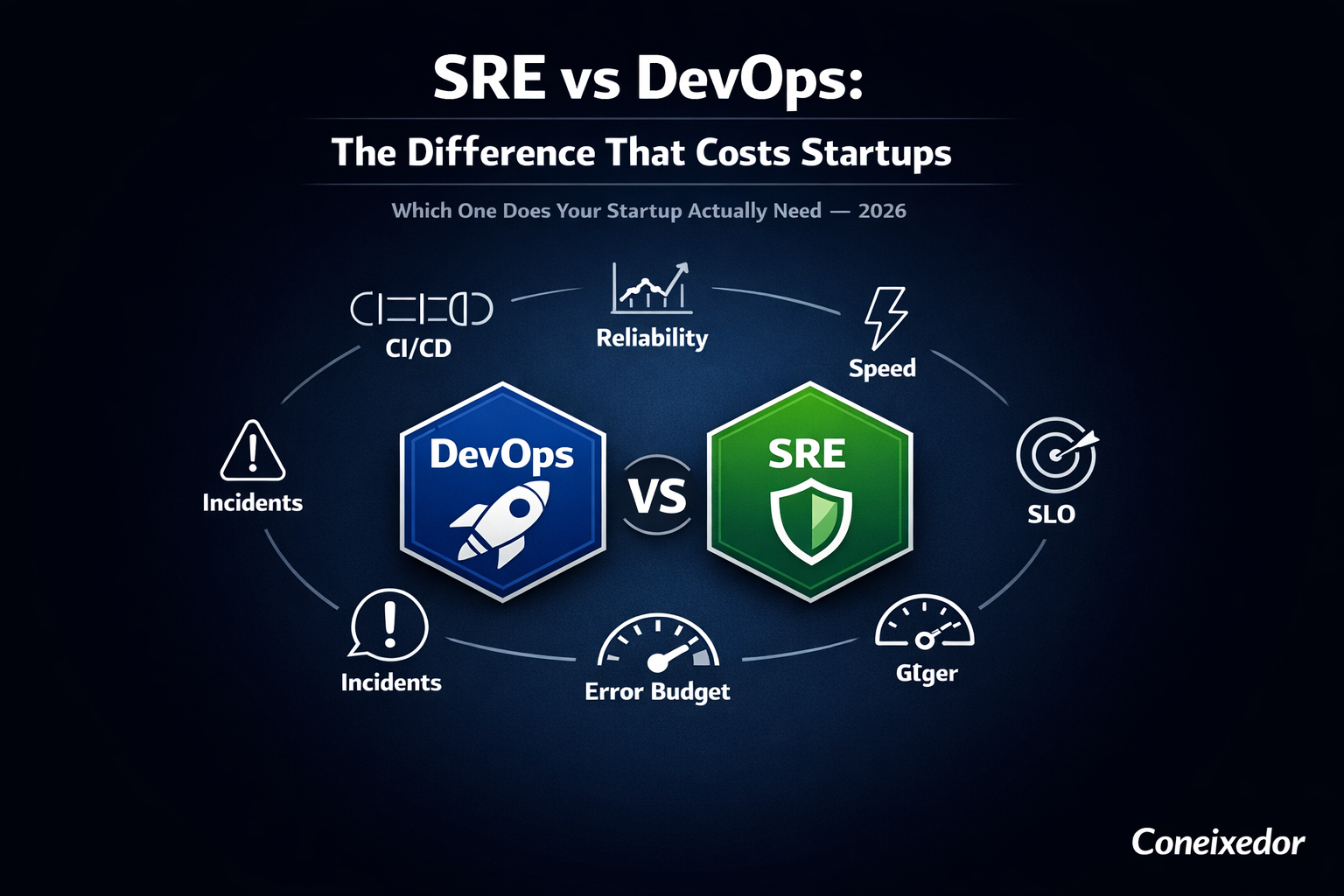
DevOps optimises for delivery speed. SRE optimises for reliability under that speed. They are not the same discipline with a different name.
DevOps tools automate the path from code commit to production. CI/CD pipelines, Infrastructure as Code, container orchestration, and deployment automation are all DevOps tooling. They answer the question: how do we ship faster? What they cannot do is answer the question: what happens when the thing we shipped breaks?
SRE practices answer the second question. SLOs (Service Level Objectives) define what reliable means for each service. Runbooks describe what to do when it fails. Incident response processes tell the team how to communicate, escalate, and resolve. A team can deploy 50 times a day and have zero SRE practices. Many do.
The cost of skipping SRE, a rough calculation
A mid-size SaaS at $50,000 MRR loses roughly $35 for every minute of downtime. Thirty minutes of unplanned outage costs $1,050 in direct revenue, before churn and trust damage.
The deeper cost is the hidden tax on every incident without a process. When an alert fires at 2am and no one knows who owns it, the team spends the first 20 minutes figuring out whose problem it is. When there is no runbook, they spend the next 40 minutes diagnosing from scratch. What should be a 15-minute resolution becomes a 3-hour all-hands. The cost is not just downtime revenue. It is engineer hours, sleep, morale, and customer confidence.
Monitoring without SLOs tells you the system is down. It does not tell you how bad it is, who should care, or what to do. You get the alert but not the answer. SRE gives you the answer.
The scenario that plays out regularly in scaling startups
The most common pattern: excellent DevOps, no SRE practices, and the first serious incident reveals every gap at once. I have seen this in fintech, healthtech, and SaaS. The setup looks the same each time.
The team has a solid CI/CD pipeline, infrastructure managed in Terraform, services running on Kubernetes, and Datadog or Grafana dashboards showing system health. A deployment goes out on a Tuesday afternoon. Something breaks. The dashboard shows red. The Slack channel fills up. No one can find the runbook because there is no runbook. The person who built that service is on holiday.
Alerts without owners and no incident process turn a 20-minute problem into a 3-hour one. The team resolves it eventually. They write a post-mortem in a Google Doc that no one reads. The same incident happens six weeks later. The realisation arrives: they have a world-class DevOps setup and a zero-practice SRE gap.
What you actually need, and the right order to build it
The answer is not SRE instead of DevOps. It is SRE practices built on top of DevOps tooling, in that order.
Under 10,000 users, keep it simple. Good monitoring, a staging environment, a rollback mechanism, and one person accountable for production health. That is enough. Investing heavily in formal SRE infrastructure before you have meaningful scale is overhead that slows you down.
Above 10,000 users, add practices in this sequence: SLOs first, because everything else depends on knowing what reliable means. Runbooks second, because they directly reduce incident resolution time. On-call rotation third, because ad-hoc escalation is the fastest way to burn out your best engineers. Post-incident reviews fourth, because the only way to stop repeating incidents is to learn from them systematically.
The startups that build both layers ship just as fast as the ones that skip SRE. They just do it without the 2am chaos. Their on-call engineers have runbooks. Their monitors have owners. Their incidents have processes. Shipping fast and staying reliable are not in tension.
If your team is shipping fast but reliability keeps you up at night, Book Your Free Infrastructure Reality Check and find out exactly which SRE practices you are missing and which ones to build first.
Frequently Asked Questions
Neither is better. They solve different problems. DevOps solves delivery speed. SRE solves reliability under that speed. You need both.
A DevOps engineer can learn SRE practices, but the mindset shift is significant. DevOps is tool-first and delivery-focused. SRE is practice-first and failure-focused.
An SRE defines SLOs, builds runbooks, designs incident response processes, runs blameless postmortems, and designs systems to fail safely. DevOps engineers typically focus on CI/CD, IaC, and deployment automation.
Both. Start with DevOps tooling to enable fast delivery. Add SRE practices above 10,000 users to keep that delivery reliable.