RAG pipelines fail in production because retrieval at scale behaves differently than retrieval in a demo. 80% of RAG failures trace to the ingestion layer, not the model. Learn the specific failure points and how production-grade RAG is actually built.
RAG pipelines fail in production because retrieval at scale has different characteristics than retrieval in a demo. Ingestion architecture, data freshness, vector search performance, and context window management all behave differently under real user load. Research shows 80% of RAG failures trace to the ingestion layer, not the model.
The demo worked. The retrieval was fast. The answers were relevant. The CTO presented to the board and everyone agreed the product was ready.
Three months into production, support tickets are climbing. The model is returning answers that are outdated, vague, or confidently wrong. The engineering team is debugging in a system that was never designed to be debugged at scale.
This is the RAG production gap. It is one of the most common failure modes in AI products in 2026, and it is almost never caused by the language model.
Why Does RAG Work in Testing and Break in Production?
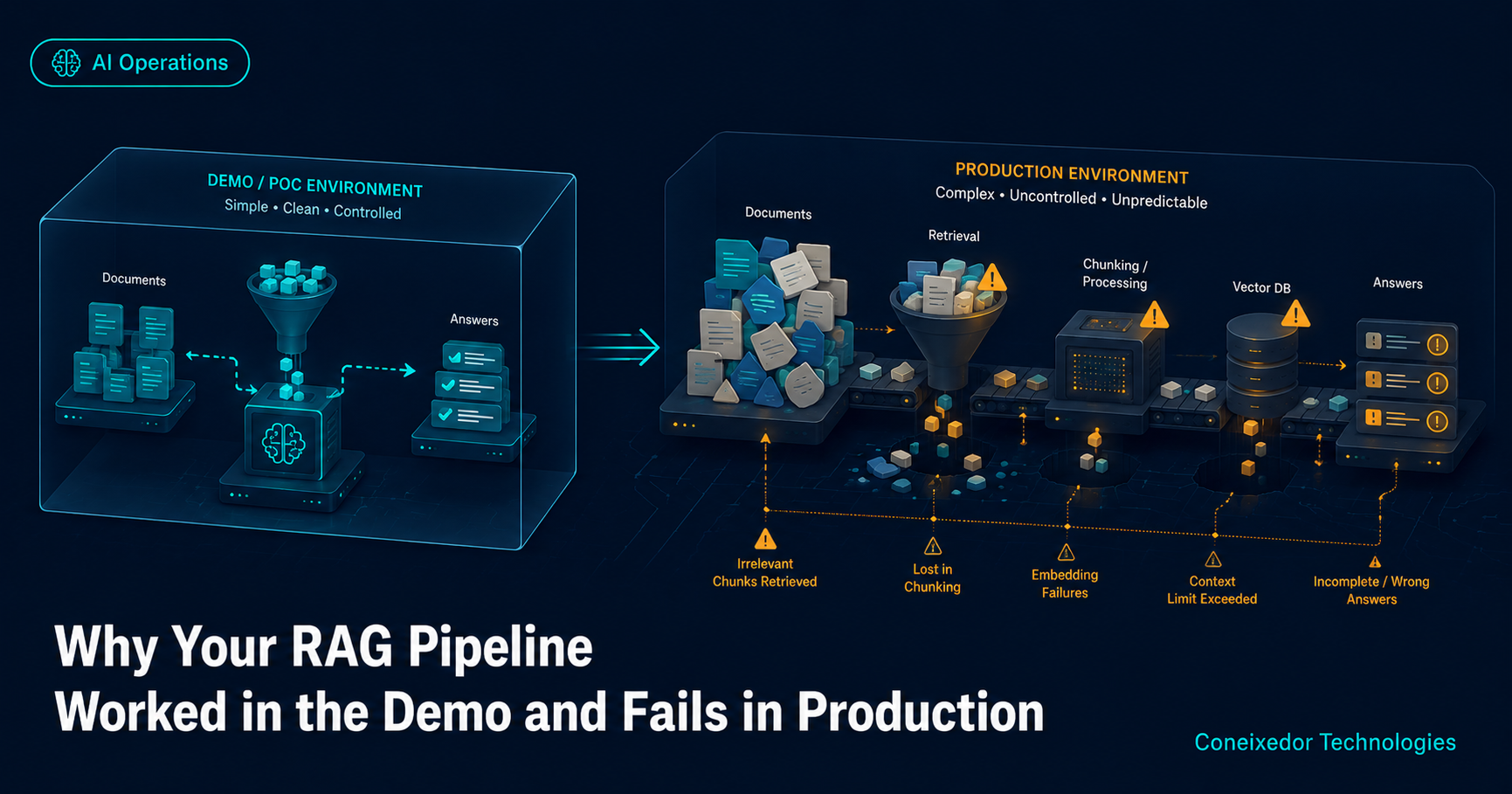
The demo environment is optimized for a small, curated dataset and a handful of known queries. Production is a different environment entirely. Real users ask questions the demo never anticipated. The data corpus grows and the ingestion pipeline that worked for 1,000 documents starts timing out at 100,000. Vector search that felt instant at demo scale now exceeds latency budgets under concurrent load.
Research identifies that 80% of RAG failures trace back to the ingestion layer, not the LLM. The data going into the vector store is stale, poorly chunked, or incompletely indexed. The model is not hallucinating. It is retrieving accurately from a broken data foundation.
The retrieval failure rate in naive RAG implementations runs at approximately 40%. Most teams do not discover this number until users are already experiencing it.
What Are the Specific Failure Points in a Production RAG System?
Ingestion failures. Chunks that are too large lose precision. Chunks that are too small lose context. Metadata that was correct at ingestion time becomes stale as the underlying data changes. An ingestion pipeline built for a weekly batch process cannot support a product that requires near-real-time data freshness.
Retrieval failures. Vector similarity search does not behave the same at 10 million embeddings as it does at 10,000. Pure vector retrieval struggles at production scale for queries that require exact term matching. Hybrid retrieval combining dense and sparse search is operationally more complex and was not in most original architectures.
Context window failures. Retrieved chunks are assembled into a context window and passed to the model. At demo scale, the chunks fit cleanly. At production scale, retrieved context frequently includes irrelevant documents, exceeds the model's context window, or conflicts internally, producing incoherent outputs that look like model failures but are retrieval failures.
Data currency failures. The retrieval layer returns the most relevant result. The most relevant result is six months old. The user receives a confident, relevant, wrong answer. This is invisible to any monitoring that only watches for pipeline completion.
How Should a Production RAG System Be Monitored?
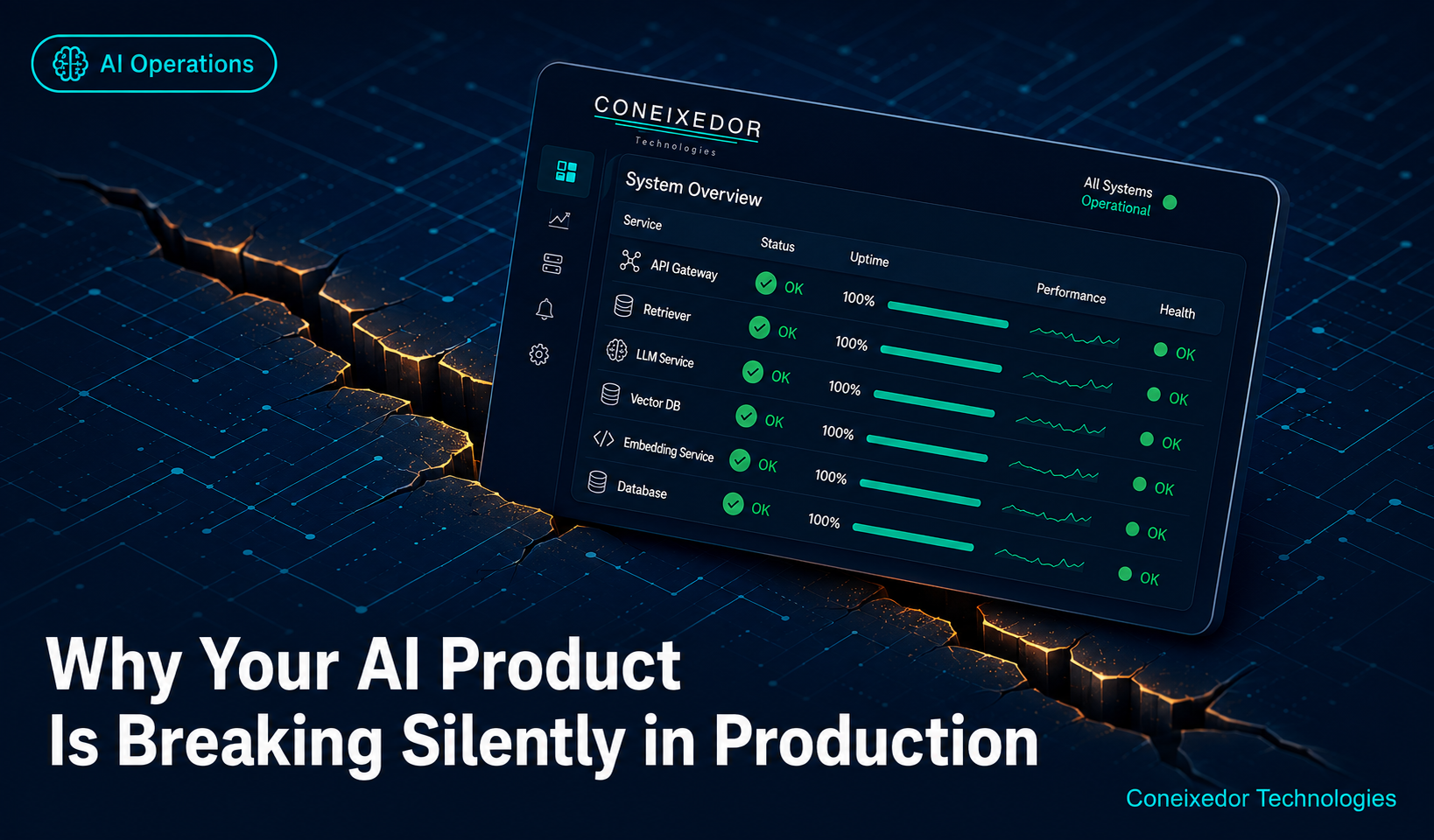
Most RAG systems are monitored at the API level. The request came in, the pipeline completed, the response went out. This tells you nothing about whether the retrieval was accurate, whether the context was relevant, or whether the model had sufficient information to answer the question correctly.
A production RAG observability stack tracks retrieval precision and recall against a validation set, context relevance scores for each chunk included in the model's input, data freshness for the corpus powering the retrieval layer, and latency at each stage of the pipeline so failures can be isolated by component.
My team built these observability patterns for a healthcare SaaS client whose SRE practice we established from zero. Before the engagement, resolution time for AI product incidents was four hours. After, it was under five minutes. The difference was not better engineers. It was infrastructure that could see what was happening.
What Does a Well-Architected RAG System Look Like at Series A Scale?
It has a defined data freshness SLA with automated pipeline monitoring against that SLA. It uses hybrid retrieval with weights tuned for your specific query distribution. It has a semantic cache for high-frequency, low-variance queries that reduces retrieval cost and latency. It has a circuit breaker that degrades gracefully when retrieval quality falls below threshold rather than passing a bad context to the model.
None of this is experimental. These are established patterns. The gap between teams that implement them and teams that do not is the gap between AI products that compound user trust and AI products that erode it.
Book Your Free Infrastructure Reality Check to assess your current RAG architecture and identify the specific retrieval failure patterns your system is carrying in production.
Frequently Asked Questions
Most RAG pipelines fail in production because they were designed for demo conditions: small datasets, known queries, and unconstrained latency. At production scale, ingestion pipelines become bottlenecks, vector search latency increases, data freshness degrades, and retrieval accuracy drops. Research shows 80% of RAG failures trace to the ingestion layer, not the language model.
Naive RAG uses basic vector similarity search with fixed chunking and no evaluation layer. Production RAG uses hybrid retrieval combining dense and sparse search, dynamic chunking based on document type, a semantic cache for high-frequency queries, retrieval evaluation metrics, and an observability stack that monitors retrieval quality independently of model quality.
Isolate the components. Pass the retrieved context directly to a human reviewer and assess its quality. If the context is good and the model answer is bad, you have a model problem. If the context is stale, irrelevant, or incomplete, you have a retrieval problem. Most teams skip this diagnostic step and blame the model when the retrieval layer is the actual failure point.
Before the first signs of user-facing failure. RAG architecture that worked at 1,000 users typically shows measurable retrieval degradation before the 10,000 user mark. An Infrastructure Reality Check call can identify whether your current architecture has the headroom for your growth targets or whether upgrades are needed now.