Engineering teams avoid Friday deployments because their pipeline doesn't give them confidence that a change is safe to ship. This is an infrastructure problem, not a culture problem. Learn what a deployment pipeline that actually builds confidence looks like for AI products.
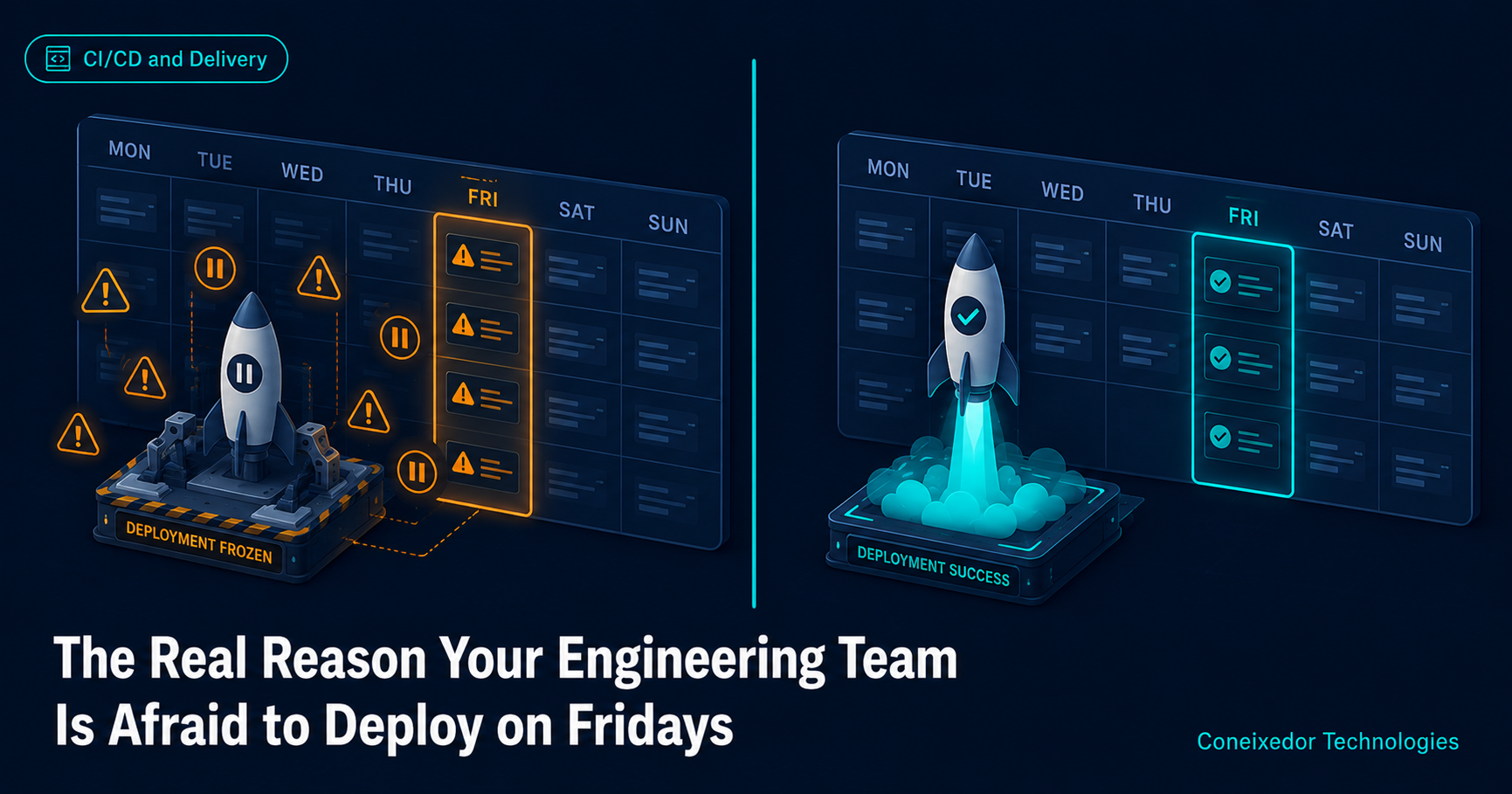
Engineering teams avoid Friday deployments because their deployment pipeline does not give them enough confidence that a change is safe to ship. This is an infrastructure problem, not a culture problem. The fix is not telling the team to be braver. The fix is building a better pipeline.
There is a simple test for the health of your engineering culture. Ask your team: would you feel comfortable deploying a significant feature on a Friday afternoon?
If the answer is no, or not really, or only if it is urgent, you have an infrastructure problem disguised as a culture problem.
The fear of deploying on Fridays is not irrational. It is a rational response to an environment where deployments are high-risk events. Where something going wrong means a weekend on-call emergency. Where rollback takes twenty minutes instead of two. Where the pipeline gives you confidence in syntax but not in behavior.
BSEduworld's Director Ravi Mohan described the state of their team before engaging my team at Coneixedor. Deployment was a stressful, carefully managed event that the team avoided whenever possible. After we rebuilt their CI/CD foundation, the outcome was: "We ship on Fridays now and nobody loses sleep over it."
That outcome is not about bravery. It is about infrastructure.
Why Do AI Product Deployments Carry More Risk Than Traditional Software Deployments?
Traditional software deployments are complex. AI product deployments add several failure modes that standard CI/CD pipelines were not designed to catch.
A traditional pipeline validates code: does the build compile, do the tests pass, does the syntax conform to standards. An AI product deployment needs to validate behavior: does the model still respond correctly to the queries it will receive in production, has any upstream provider change affected the output distribution, has the retrieval layer been properly updated to include the new data the feature depends on.
Most AI startups deploy their AI product through a pipeline designed for traditional software. The test suite validates the plumbing. Nothing validates the intelligence layer. A deployment that passes all tests can still silently degrade the user experience because no test was asking the right questions.
What Does a Deployment Pipeline That Gives Engineers Confidence Actually Include?
A deployment pipeline for an AI product needs three things that most startups do not have:
Behavioral tests. A curated set of inputs with expected output ranges that run automatically before any deployment reaches production. Not just unit tests for functions. Behavioral tests for the model layer that can detect if a change in prompt, retrieval configuration, or provider version has shifted output quality.
Progressive rollout infrastructure. Canary deployments that send a small percentage of traffic to the new version before full release. Combined with real-time monitoring of behavioral metrics, a canary deployment lets you catch problems before they affect all your users.
One-command rollback. A deployment that takes twenty minutes to roll back is a deployment the team will avoid making until they are absolutely certain. A deployment with one-command rollback that completes in two minutes is a deployment the team can make with confidence. The infrastructure difference between these two scenarios is significant. The behavioral difference in your engineering team is dramatic.
What Is the Business Cost of Deploy Fear?
It compounds. A team that deploys once a week instead of five times a week is accumulating a backlog of changes that grow larger and riskier over time. Larger, riskier deployments fail more often. Each failure reinforces the fear. The cycle tightens.
The causal chain from deploy fear to competitive disadvantage is direct. Your competitor is shipping features while your team is waiting for the safe window. Your competitor is iterating on user feedback while your team is managing the risk of the last release.
Deploy frequency is not a vanity metric. It is a measure of your team's confidence in their infrastructure and a leading indicator of your product's rate of improvement.
BSEduworld achieved 45% faster deployments after my team rebuilt their foundation. Zero deployment failures since go-live. The team that had been afraid to ship now ships routinely, on any day of the week.
What Should an AI Startup Do First?
Start with a baseline. Count how many times your team deploys per week. Time how long rollback takes on your current system. Ask your engineers honestly whether they would deploy on a Friday. These three numbers tell you most of what you need to know about where your pipeline is failing them.
The infrastructure that creates deploy confidence is not complex to describe. It requires deliberate investment to build. Most AI startups at the seed to Series A stage have never built it because the product work always seemed more urgent. By the time the problem is visible, it has cost the team significant velocity and the CTO significant credibility.
Book Your Free Infrastructure Reality Check to understand whether your current pipeline is giving your engineering team the confidence to move at the speed your product requires.
Frequently Asked Questions
Friday deployments are considered risky because problems that occur over a weekend have fewer engineers available to respond. But this is a symptom, not the root cause. The root cause is a deployment pipeline that does not provide enough confidence that a change is safe. Teams with behavioral testing and one-command rollback capability deploy on Fridays without concern.
Continuous integration validates code quality: builds, tests, and syntax checks. Continuous delivery for AI products must also validate behavioral quality: whether the model still responds correctly, whether the retrieval layer is functioning, and whether upstream provider changes have shifted output behavior. Most AI startup pipelines have the former and lack the latter.
Ask the team directly how comfortable they are deploying on a Friday afternoon. Track deployment frequency over time. Measure rollback rate and mean time to recovery. Deployment frequency below twice per week in a product-stage AI startup is typically an infrastructure problem, not an attitude problem.
In order of impact: behavioral test suites for the model layer, progressive rollout with real-time behavioral monitoring, and sub-five-minute rollback capability. Teams that implement all three typically see deployment frequency increase two to three times within the first quarter after implementation.