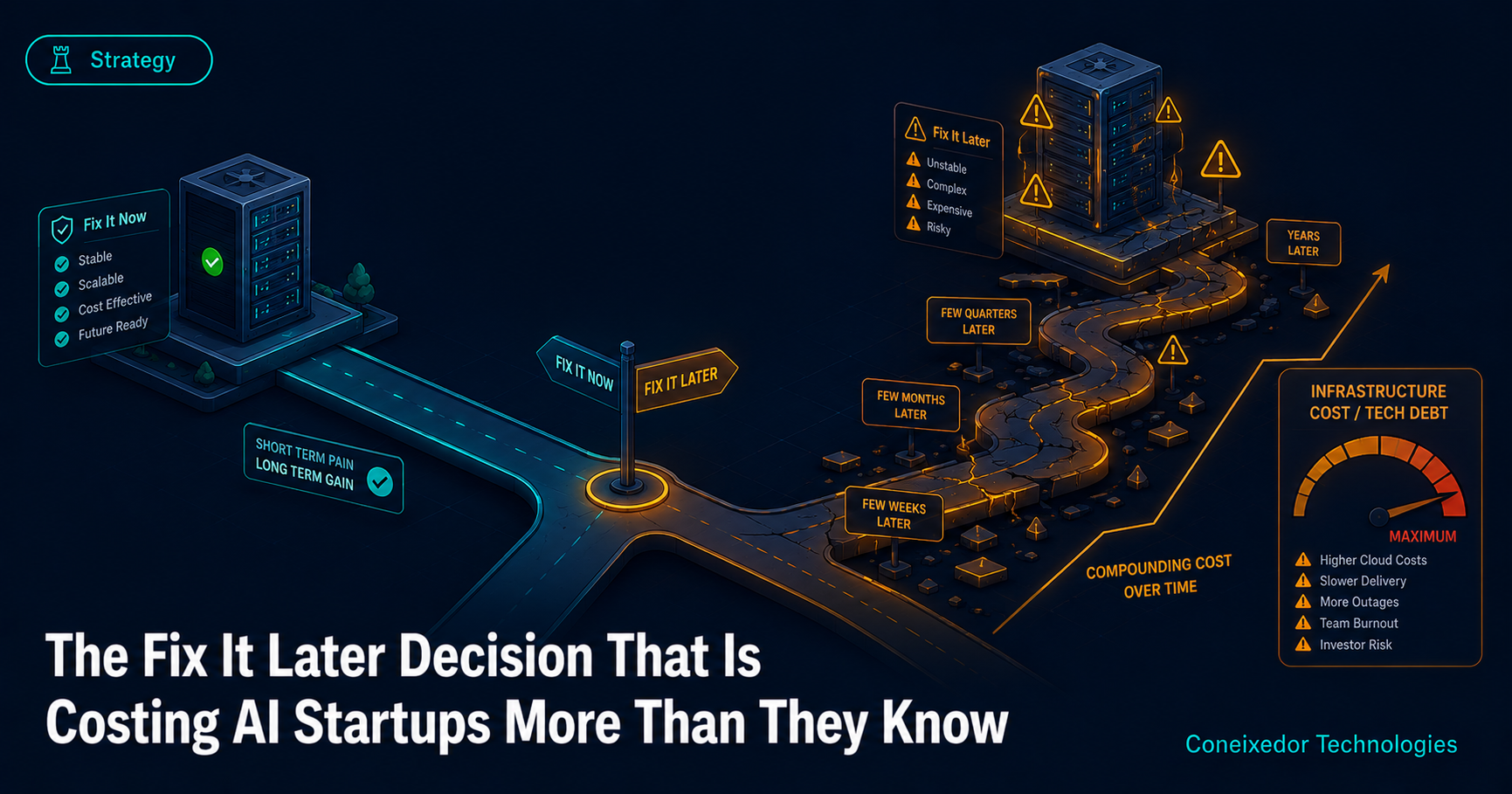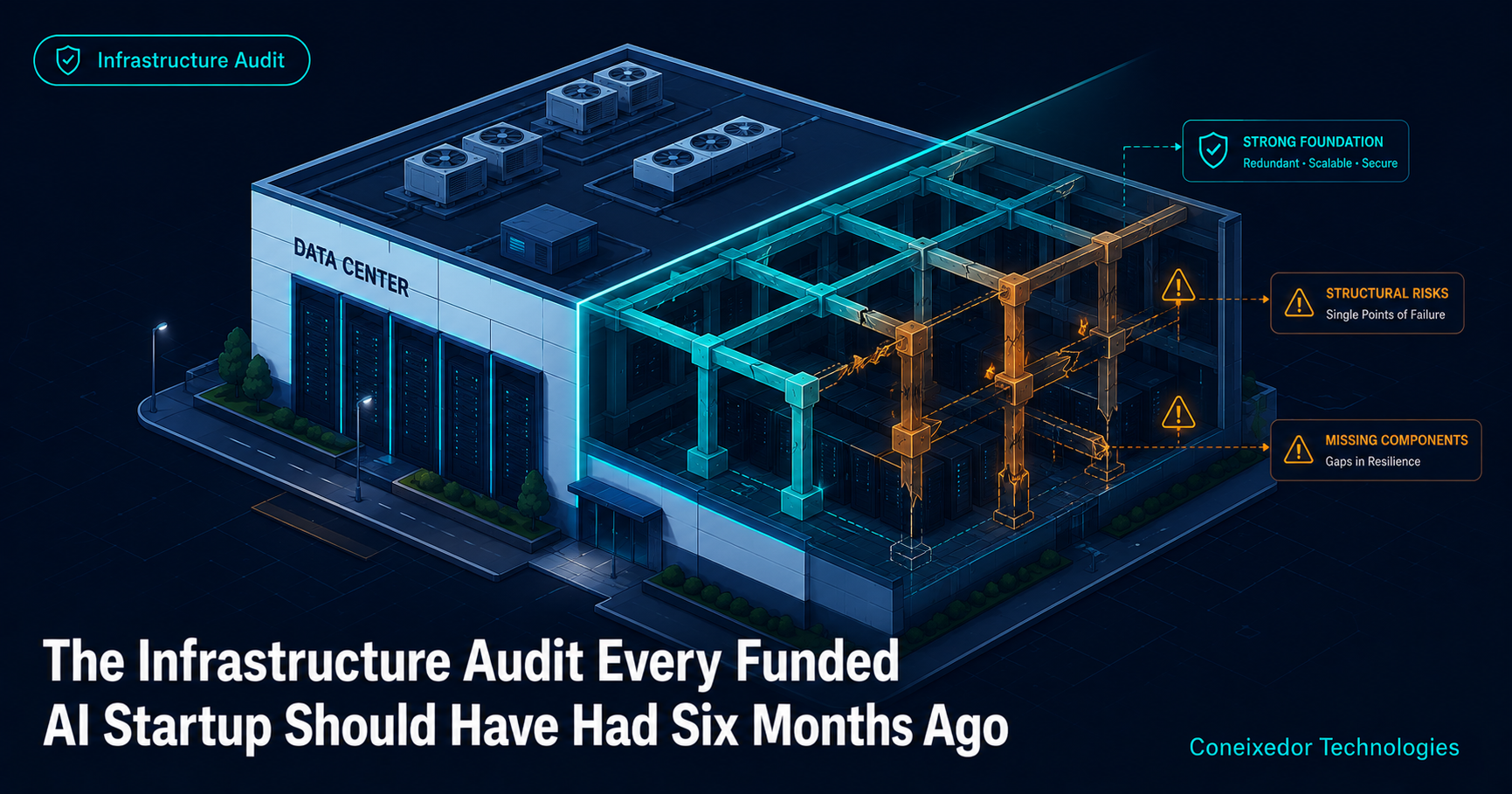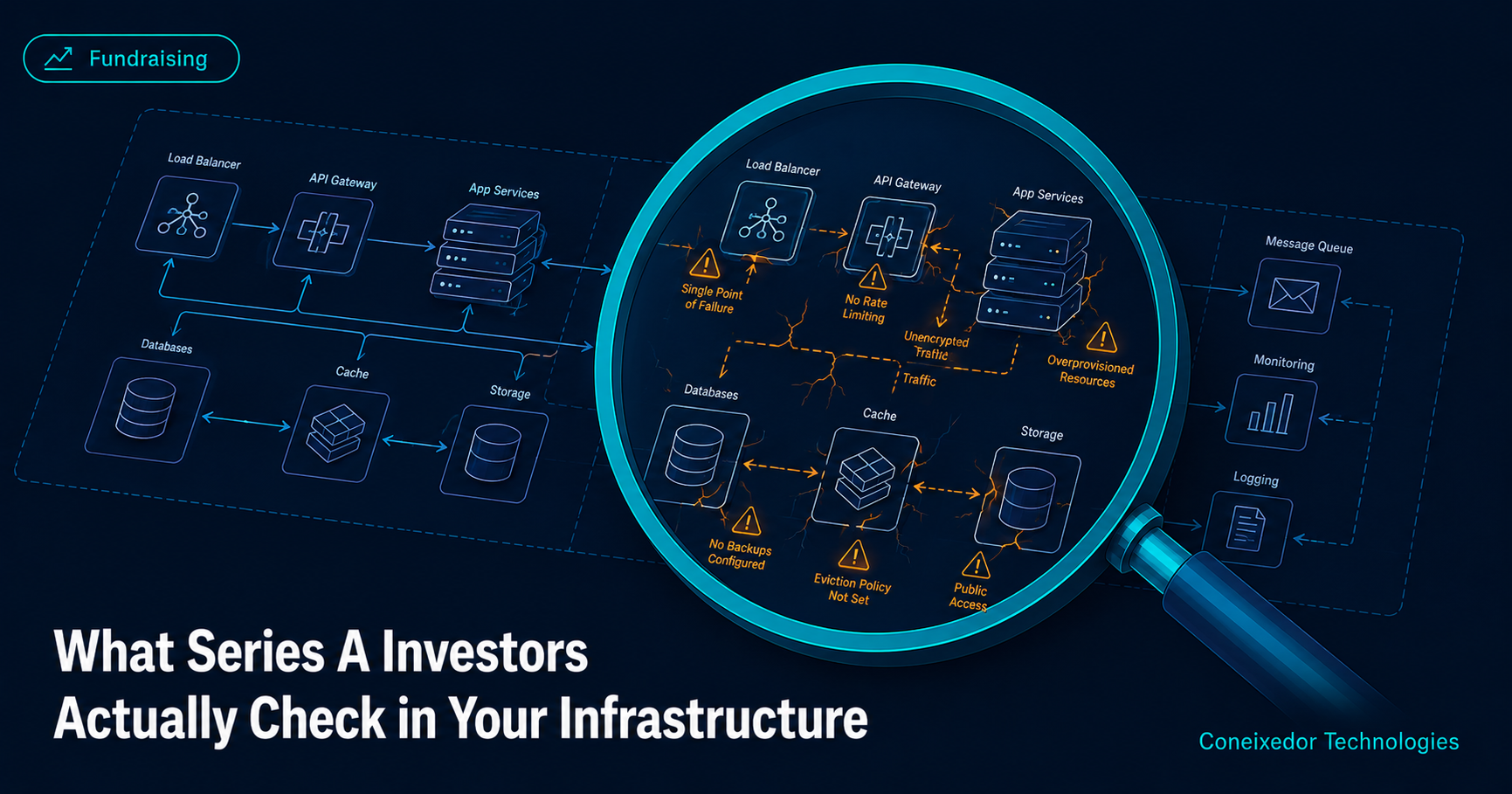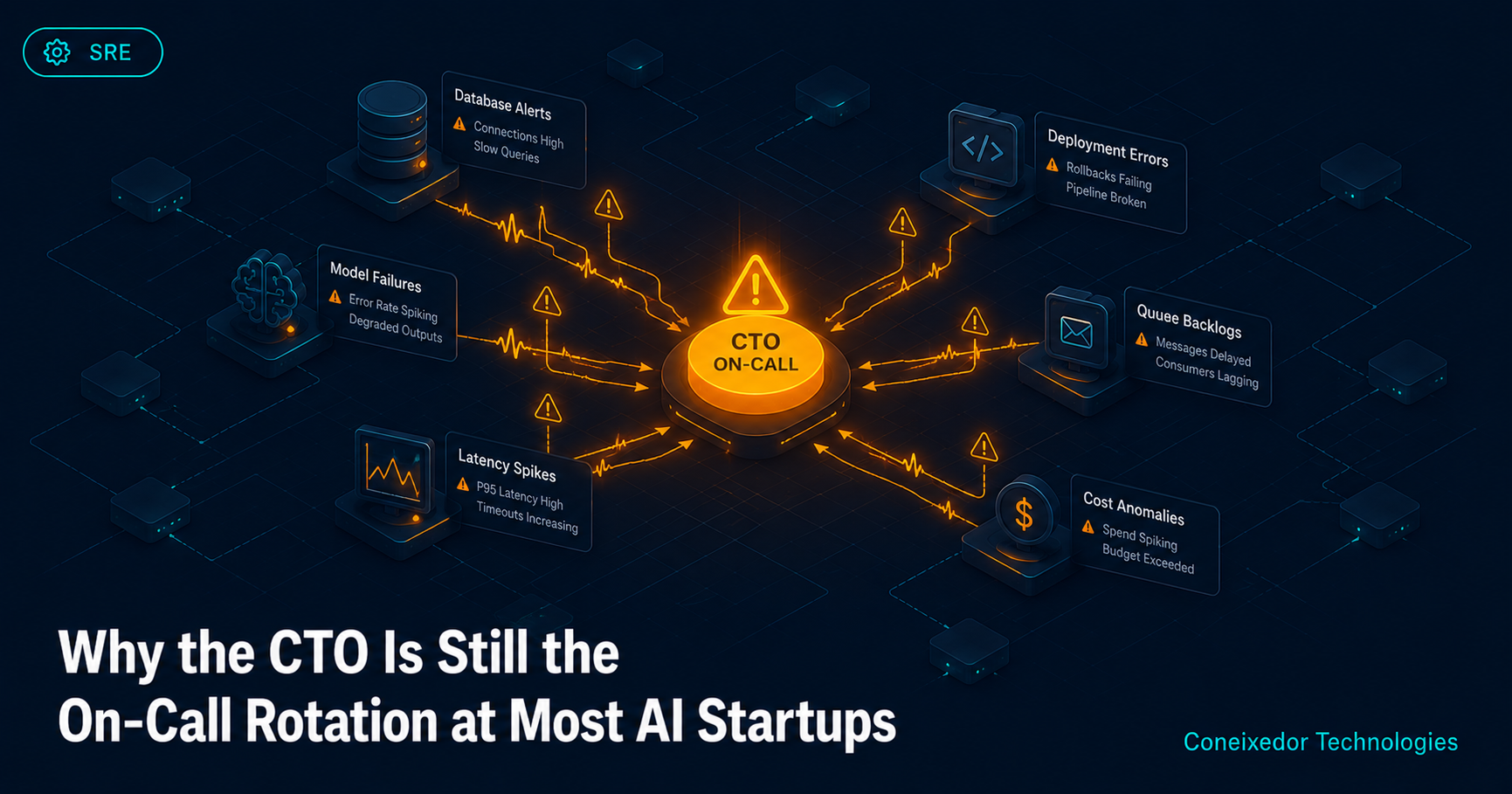
Most AI startup CTOs are still personally responding to infrastructure incidents because the team lacks the practices, documentation, and tooling to respond independently. This is an infrastructure problem with a direct cost to product velocity, team autonomy, and fundraising.
Most AI startup CTOs are still personally responding to infrastructure incidents because their team lacks the practices, documentation, and tooling to respond independently. This is not a confidence problem. It is an infrastructure problem. And it gets more expensive as the company grows.
At 2am on a Wednesday, the CTO of a Series A AI startup is responding to a Slack alert. The model inference layer is returning degraded results. The on-call engineer escalated because they do not have the context to debug it alone. The CTO does.
This scenario is common enough to be unremarkable. Most founders and CTOs of AI startups in the seed to Series B range are informally part of their on-call rotation, even if they are not formally listed.
This is not a sign of dedication. It is a sign of infrastructure debt.
Why Are CTOs Still Personally Responding to Production Incidents?
The Catchpoint SRE Report 2026 surveyed 418 SRE practitioners and found median toil at 34% of working time. In the absence of a formal SRE practice, that toil falls on whoever has the most context. In an early-stage AI startup, that person is usually the CTO or the founding engineer.
The root cause is not that the CTO is too hands-on. The root cause is that the team has not been set up with the infrastructure to handle incidents independently: documented runbooks, clear escalation paths, observable systems, and the operational context to diagnose problems without calling the person who built them.
AI products add a specific complication. Infrastructure incidents span a broader range than traditional software incidents. A latency spike might be an infrastructure problem, a retrieval problem, or a model behavior problem. Without observability across all three layers and documentation that helps a less experienced engineer navigate the diagnostic tree, the incident automatically escalates to whoever has the full picture.
What Is the Business Cost of CTO-Level On-Call Dependency?
The cost has four components.
The direct cost is the CTO's time. An incident that takes two hours of CTO time is two hours not spent on product direction, hiring, or fundraising. A CTO who averages three incidents per week is losing six or more hours per week to reactive operations. Over a quarter, that is significant.
The indirect cost is the ceiling it creates on team autonomy. A team that knows the CTO will respond to hard incidents stops developing the capability to handle hard incidents. The dependency deepens over time. The CTO cannot build out the on-call rotation because the team is not ready. The team is not ready because they have not been given the infrastructure to become ready.
The growth cost is the most significant. A CTO whose attention is regularly divided by production incidents is a CTO who is not focused on the decisions that compound over time: product direction, technical architecture, team building, and the narrative the company tells about its operational maturity.
The fundraising cost surfaces at Series B. Investors at this stage are evaluating whether the team can operate the company without founder dependency. A CTO who is still the de facto incident response layer is evidence that the organization has not scaled past its founding team's capacity.
What Does a Proper SRE Practice for an AI Startup Look Like?
It does not look like a ten-person reliability team. At the seed to Series A stage, a proper SRE practice has five components:
Documented runbooks for the ten most common incident types, written at the level of detail where a mid-level engineer can follow them without additional context. Clear escalation criteria that define what gets resolved at the first responder level and what requires senior involvement. Observability coverage that makes the diagnostic path visible rather than relying on institutional knowledge. A post-incident review process that converts each incident into improved documentation and tooling. And on-call rotation hygiene that distributes the burden equitably and does not silently default to the CTO when the team is uncertain.
My team builds these practices for AI startups in our managed SRE retainer. A healthcare SaaS client went from a reactive, founder-dependent incident process to a team-operated SRE practice. Incidents per month dropped 70%. Resolution time went from four hours to under five minutes. The founding team got their nights back.
When Should an AI Startup Formalize Its SRE Practice?
Before it needs one. The most expensive time to build an SRE practice is during an incident that has already cost you a customer relationship, a contract, or a fundraising conversation.
A three-month managed SRE retainer with Coneixedor includes the full practice build, not just coverage. Runbooks, escalation paths, observability configuration, on-call tooling, and the documentation that lets your team operate independently. The goal is a team that does not need to escalate every hard incident to the CTO. The outcome is a CTO who is focused on what only they can do.
Book Your Free Infrastructure Reality Check to assess your current incident response posture and understand what an SRE practice would change for your team.
Frequently Asked Questions
Because the team has not been set up with the infrastructure to handle incidents independently: documented runbooks, clear escalation paths, and observability that makes the diagnostic path visible. In the absence of these, incidents escalate to whoever has the most context, which is usually the CTO or founding engineer.
An SRE practice is a set of documented processes, tooling, and runbooks that allows an engineering team to respond to production incidents without dependence on senior founder involvement. It reduces toil, improves resolution time, and builds team capability. AI products need SRE practices earlier than traditional software products because they have more failure modes across model, retrieval, and infrastructure layers.
Before a critical incident makes the absence visible. The optimal window is before Series A, when the team is growing past the founding team's direct oversight but before the operational complexity of a larger product and customer base makes the gaps costly. Building an SRE practice during an active incident is significantly more expensive than building one before.
A meaningful baseline practice can be established in four to six weeks. A mature practice that operates reliably without senior founder involvement typically takes three months to build and validate. Coneixedor's managed SRE retainer covers the full practice build including runbooks, escalation paths, observability configuration, and on-call tooling.