AI inference costs spiral for most funded startups because GPU utilization is low, zombie resources accumulate, and token economics are poorly understood. Learn what actually drives your bill and which infrastructure changes have the highest ROI.
AI inference costs grow faster than revenue for most funded startups because GPU utilization is low, zombie resources accumulate, and token economics are poorly understood. Fixing this requires infrastructure-level changes, not just switching to a cheaper model.
There is a moment most AI startup CTOs recognize. You are reviewing the cloud bill for the second month in a row and the number is larger than last month but the usage metrics do not fully explain why. You spend two hours trying to connect the cost to the growth and something does not add up.
This is the inference cost problem. It does not arrive as a crisis. It arrives as a slow, compounding pressure on unit economics that eventually becomes visible at the board level.
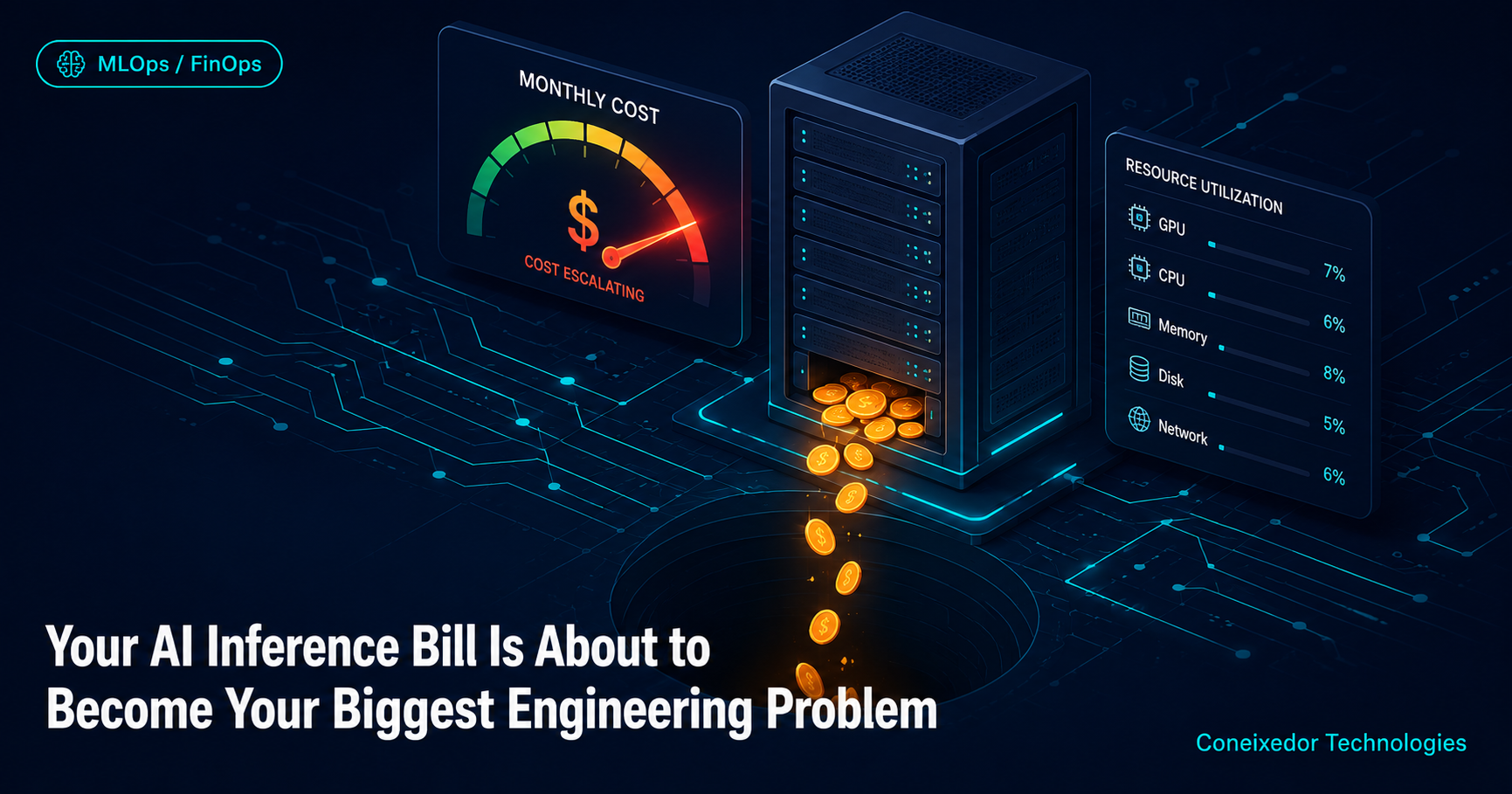
VentureBeat reported on the five percent GPU utilization phenomenon: enterprises allocating hundreds of millions in GPU capacity that sits idle the majority of the time. The problem is not unique to large organizations. AI startups building on cloud providers experience the same structural issue at a smaller scale, with proportionally larger consequences for their cost base.
According to the 2026 State of FinOps report, cloud waste rose to 29% for the first time in five years. AI workloads were the primary driver.
Why Does AI Inference Cost Spiral Out of Control?
The core issue is that inference infrastructure is designed for peak load, not average load. An AI startup configures its serving layer to handle the highest-traffic moment it has ever seen. The rest of the time, those resources are idle. You are paying for capacity you are not using.
This is compounded by what practitioners call zombie GPUs: resources that were allocated for a specific purpose, never explicitly decommissioned, and quietly billing. Weekend notebooks, staging environment clones, fixed-capacity inference configs that were never updated as the product scaled. Each line item is small. The sum is significant.
Industry analysts estimate 55 to 80% of enterprise AI GPU spend goes to inference. The training costs that dominated early AI infrastructure conversations have largely been absorbed by foundation model providers. The cost center that remains is yours: every request, every token, every API call your product makes to serve a user.
What Are the Specific Categories of Hidden AI Infrastructure Cost?
My team identifies eight cost buckets in a standard AI infrastructure review, beyond the metered token bill that shows up in your provider's dashboard:
Retrieval and data costs, particularly for RAG-based systems where vector similarity search at scale is more expensive than teams expect. Orchestration overhead from agentic workflows that chain multiple model calls. Idle GPU capacity in inference infrastructure. KV cache mismanagement. Redundant staging environments. Monitoring and logging infrastructure set up without cost boundaries. And the engineering time absorbed by manual cost investigation, which does not appear in any cloud bill but is real.
How Much Can Infrastructure Changes Actually Reduce AI Inference Costs?
The range is significant. FP8 quantization delivers 1.3 to 2x throughput gains over FP16 at under 2% quality loss on instruction-tuned models. Prompt caching on high-reuse workloads returns 90% savings on cache-hit tokens with near-zero implementation cost and zero accuracy risk.
BSEduworld, a funded EdTech platform, achieved 60% cost reduction after my team rebuilt their infrastructure layer. The saving came from a combination of model routing, caching, and eliminating zombie resources. No model swap. No capability reduction. Infrastructure changes only.
What Is the Right Unit Economics Metric for AI Infrastructure?
The metric that matters is not cost per token or cost per API call. It is cost per successful output: the total inference cost divided by the number of outputs that pass your quality gate. This is the metric that connects infrastructure spend to business value and makes the ROI of cost optimization legible to a board.
Most AI startups are optimizing for the wrong number. They negotiate a better per-token rate with their provider and consider the problem solved. The idle capacity, the zombie resources, the retrieval overhead, and the orchestration costs remain untouched.
When Does Inference Cost Become a Fundraising Problem?
When the unit economics do not hold at scale. A Series B investor looking at an AI startup's financials will model the infrastructure cost as a function of growth. If the cost grows linearly with users or faster, the business model has a structural problem. If the cost grows sublinearly because the infrastructure is well-designed, that is evidence of operational maturity.
Infrastructure that is not cost-efficient at your current scale will not become efficient at the next scale. The time to address it is before you have committed to growth targets that assume efficiency you have not built.
Book Your Free Infrastructure Reality Check to understand where your inference costs are actually going and which changes would have the highest impact on your unit economics.
Frequently Asked Questions
Training is a one-time cost shared by the model provider. Inference is ongoing: every user request generates compute cost. At production scale, inference becomes the dominant cost category, with analysts estimating 55 to 80% of enterprise AI GPU spend goes to inference. Most AI startups underestimate inference costs in their financial models because early usage is too low to reveal the true cost structure.
Zombie GPUs are compute resources allocated for a specific AI workload that were never explicitly decommissioned. They accumulate across staging environments, expired experiments, and fixed-capacity inference configs that were never updated. Each generates idle cost without generating value and is one of the largest waste categories in most AI infrastructure bills.
Start with prompt caching for high-reuse workloads, model routing for different task types, and eliminating idle resources. Quantization techniques like FP8 can reduce inference GPU cost by 50 to 75% with minimal quality impact on instruction-tuned models. An Infrastructure Reality Check identifies which lever has the highest ROI for your specific stack.
Before Series A fundraising. Your unit economics will be a key diligence area and any structural inefficiency in your cost base will be visible to an experienced technical investor. The free Infrastructure Reality Check call covers your current cost structure, specific waste categories, and a prioritized set of changes.